First time to the racetrack or seasoned pro you can find the answers to your questions below. If you can't find the answer to your question drop us an email, we are here to help.
What is a HPDE?

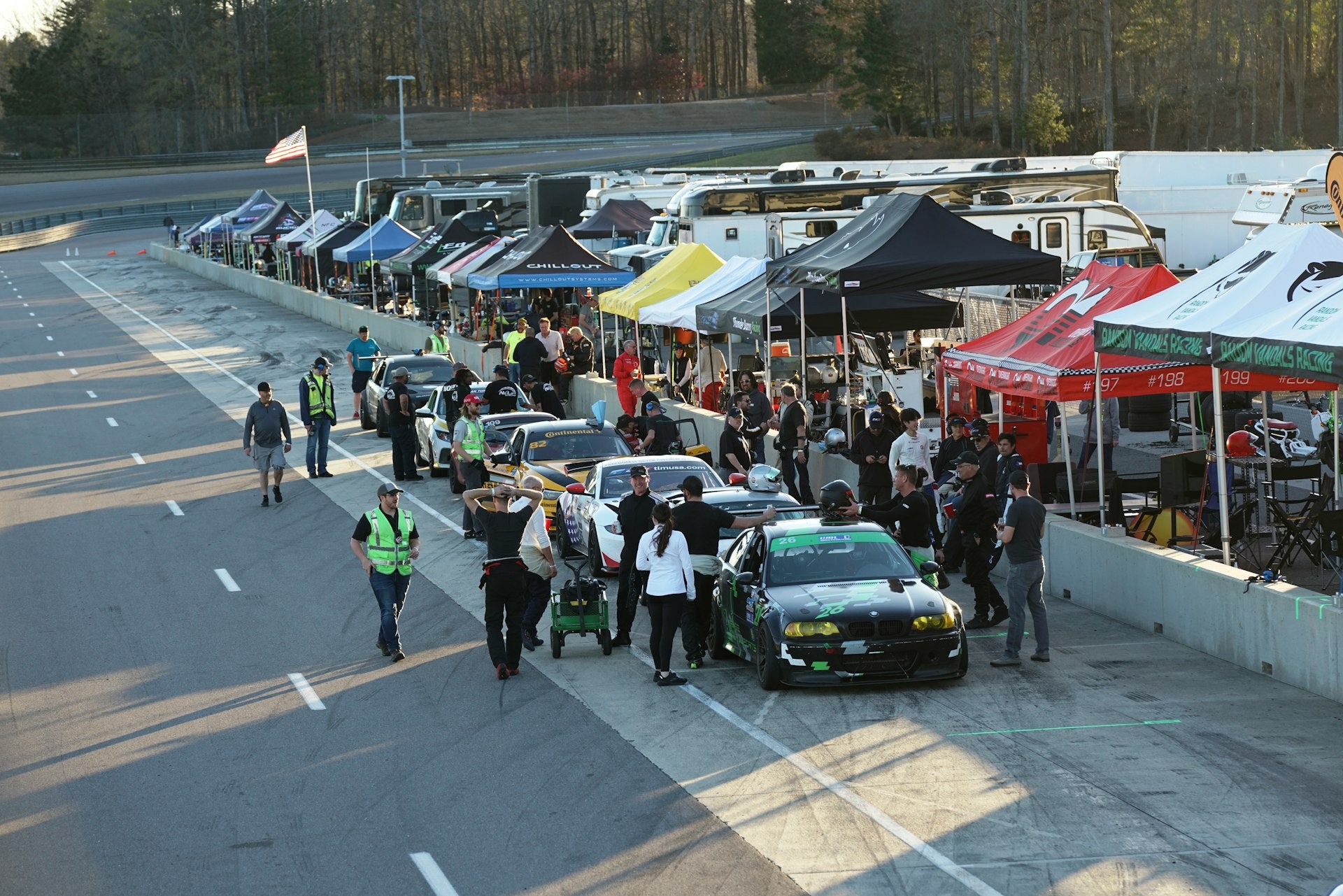
A HPDE (High Performance Driver Education) is a non-competitive driving school that teaches people how to drive at high speeds on a racetrack.  HPDE events provide a safe, controlled environment for drivers to push the limits of their car and themselves.  At a HPDE event the focus is on developing driving skills and learning to handle your vehicle at its limits. 

Who Can Participate?

Our events are open to almost every brother and sister with a car and a passion for driving.  There is no prior experience needed to get on track, just be sure you meet the below requirements.


Age Limit

Drivers must be 18 years of age or older at the time of the event.

Helmet Requirement

All persons going on track (driver and passenger) are required to wear a helmet which has a SA2020 or SA2025 rating, motorcycle helmets ARE NOT allowed. This helmet rating is printed inside of the helmet, and will be clearly marketed as having a SA2020 or SA2025 rating.

There is a limited supply of helmets for rent at Carolina Motorsports Park on a first come first served basis.

Attire Requirement

All persons going on track (driver and passenger) should wear long pants, tee shirt or long sleeve shirt, and closed toe shoes. It is strongly recommended that you not wear synthetic materials, cotton and wool are the preferred materials.

What Vehicles Can Participate?

Most four wheeled vehicles are permitted so long as they meet the minimum safety requirements outlined in the Tech Inspection Sheet and are well maintained.  You don’t need a highly modified racecar to participate, in fact most people bring unmodified daily drivers.  We love seeing the diversity of cars that our friends bring out to the track; classics, muscle, JDM, DSM, exotic, etc. are all welcome so long as they meet the following requirements:

Vehicle Inspection

All vehicles should be inspected by a competent mechanic shortly prior to the track day to confirm that they meet the minimum requirements set forth on the Tech Inspection Sheet. Vehicles which fail the tech inspection at the track will not be permitted on track until the issue(s) have been satisfactorily resolved.

Permitted Vehicle Types

As mentioned most four wheeled vehicles are permitted.

Not Permitted on Track:

  • UTVs
  • Motorcycles
  • SUVs (see below)
  • Trucks (see below)

The following vehicles may be permitted but require pre-approval, just drop us an email and let us know what you have.

  • Sport Trucks
  • Sport SUVs
  • Open wheel or purpose built race cars

Convertible Vehicles

Convertibles are allowed on the track, but they must meet one of the following requirements. If you’re unsure, don’t hesitate to reach out to us for assistance in determining if your convertible is permitted.

  • Convertibles with a folding hard top, or removable hard top are permitted so long as the top remains on the vehicle while on track.
  • Convertibles which come from the factory with a deployable or pop up rollbar are permitted.
  • Convertibles with a factory-installed roll bar are permitted, provided that the manufacturer specifies that the roll bar can support the vehicle’s weight in a rollover scenario. Additionally, the driver and passenger must be able to pass the broomstick test while wearing a helmet.
  • Convertibles equipped with an aftermarket rollbar designed to carry the weight of the vehicle in a rollover situation are permitted so long as the driver and passenger can pass the broomstick test with helmet on.

What to Expect?

Never done a track day before, first time driving with Auto Paradise, unsure what to expect?  The basics of what to expect are outlined in this section as well as The HPDE 1st-Timer's Guide linked to the right.  If you have any questions or concerns just drop us an email.

Schedule

The morning starts out early when you get checked-in with Auto Paradise staff. At the check-in we confirm all your information, inspect that your helmet meets requirements, and get you setup for the technical inspection of your vehicle (please refer to the vehicle and driver requirements section of the FAQ). Around 8 AM there is a mandatory drivers meeting where we will discuss safety items, the rules, the schedule for the day, and the daily text.

The track goes hot at 9 AM and run groups take turns driving on the track until the lunch break at noon. After lunch the track goes hot again and run groups take turns driving until 5 PM when the on track activities stop. Throughout the day there will be mandatory and optional learning sessions (depending on what run group you are in) that focus on safety and driving related topics.

Run Groups

All drivers are assigned a run group based on experience.  Each run group has a specified time on track (usually a 20 minute session every hour).  During your session you can drive as much or as little as you want.

Instructors

The main goals of our events are; be safe, have fun, and improve.  A big component in acheiving all of those goals is instruction.  To that end we work to be sure we have instructors available to assist drivers whether it's their first time on track or their 500th time

HPDE 1st-Timer's Guide

For a much more in depth look at what to expect at a HPDE we recommend The HPDE 1st-Timer's Guide by Ross Bently. This is a free to download e-book that gives a great overview of what you can expect at a HPDE. While not everything covered in this booklet applies to our event there is a multitude of good information to help 1st timers to prepare.

Preparing Your Vehicle

As Witnesses we understand the sanctity of life, a big way we can show our respect for the sanctity of life is by ensuring that our vehicle is safe for use on the track.  By taking the time to inspect our vehicle and handle general maintenance we show that we respect our lives and the lives of our other track brothers and sisters.  Preparing a car for the track is all about safety and maintenance.  There is no long list of modifications that must be completed before getting on track, in fact we recommend starting out with a fairly stock car as this allows you to approach the limits at a much safer speed and identify the key areas that need to be upgraded.

Vehicle Inspection

The most important part of preparing your car for track use is to be sure that the vehicle is safe. Shortly before the event you should have your car inspected by a competent mechanic to be sure it is safe to take on track. Our Tech Inspection sheet provides a set of minimum requirements each vehicle must meet and should be filled out prior to the event.

It is your responsibility to ensure that your vehicle is inspected and ready for track use.  The morning of the event each car will be inspected by one of the Auto Paradise crew to ensure that it meets the minimum requirements. Vehicles which fail the tech inspection will not be permitted on track until the issue(s) have been satisfactorily resolved.

Brake Fluid

We strongly encourage all drivers to flush and replace their brake fluid each year with a racing brake fluid that has a high boiling point of 600 degrees or higher.  This is crucial because the extreme braking conditions on a racetrack can generate immense heat, which can cause standard brake fluid to boil, resulting in the brakes becoming ineffective due to the formation of compressible gas in the brake lines, potentially leading to loss of braking power and a dangerous situation.

Brake Pads

We strongly encourage all drivers to replace their brake pads with a track focused brake pad.  Standard street brake pads can quickly overheat and become ineffective under the demanding conditions of track use.  Racing brake pads are specifically designed to withstand the extreme heat generated during repeated hard braking on the track, offering consistent friction and stopping power even at high temperatures.

Preparing Mentally

We recommend taking time to prepare mentally before the track day.  Studying this information before the event lays a solid foundation that means you can focus more of your attention on actually driving.

Review the Rules

Please take a moment to review out general High Performance Driver Education rules.

Review the Flags

Track workers use a series of colored flags to communicate information to drivers that helps keep them safe.  All drivers should take time to study the flag meanings and how to react to them.  You can find these flags HERE.

Learn the Track

Drivers need to learn the racetrack to understand the track's unique characteristics, including braking points, corner locations, and ideal driving lines, which allows them to drive safely within the controlled environment of the track.  A great way to do this is by watching instructional videos which show the proper driving line for the track.  Driving the track on a racing simulator can help familarize drivers with the track in a no risk environment.

What to Bring?

Refer to our track day checklist for items that most drivers typically bring with them.  Keep in mind you don't need to bring all of these items (other than the helmet), and if you forget something more than likely one of your brothers or sisters will be happy to help you out with a loaner.

Spectators and Passengers

We love being able to share our sport with as many of our brothers and sisters as we can.  There is no charge for spectators and all brothers and sisters are welcome to attend and share in the fun and good association at our events.  Whether you are just wanting to walk the paddock and check out the diverse collection of cars, find a comfy spot to watch the cars zip by on track, or want to grab a helmet and ask your favorite car to take you for a few laps (passengers must be 18 years of age or older) we encourage you to attend and experience the Auto Paradise.